Wireless links in the field (2006)
 July 23, 2026
In December 2006 I was the IT lead on the Romanian Motorway Project, working out of the camp at Săvădisla. The construction ran along kilometres of alignment through the hills west of Cluj, and the sites that needed data were exactly the ones with no cable to them and no realistic way to get one. So I built the links out of the air, using cheap consumer routers and a set of antennas, and I wrote up how I did it. This is a short retrospective on that work, with the field photos from the original guide.
The point of the links was to put the site engineers online where they worked. With a connection at the work front they could pull down the latest technical drawings, update measured quantities, and report progress without driving anywhere. That saved a large amount of money in fuel alone, and it kept people off the roads, which was a real safety gain on a motorway construction site. It also saved engineering time: the right drawing arrived in minutes instead of a round trip back to camp.
The idea#
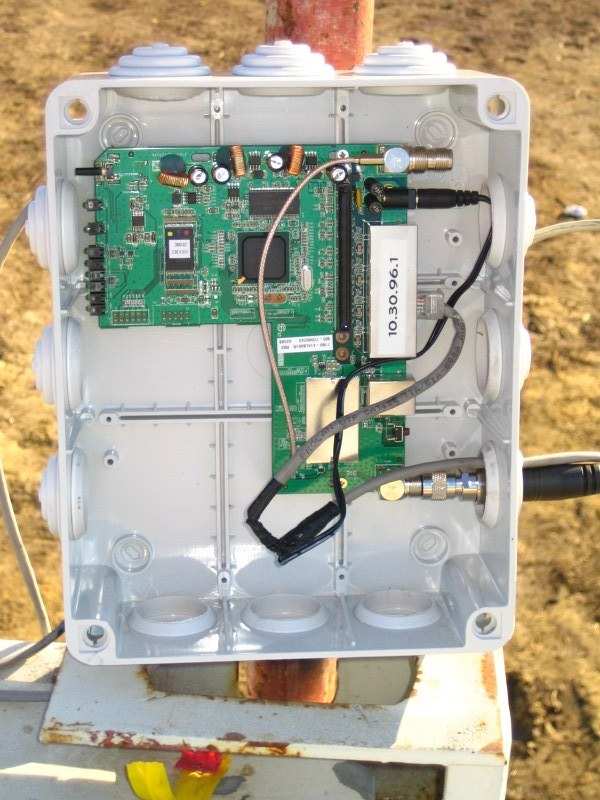
The whole approach was to keep the price down by using standard off-the-shelf equipment. The router I settled on was the Linksys WRT54GL, mostly because I could actually buy it. The trick was the firmware: the stock Linksys software is fine for a home, but I reflashed every unit with DD-WRT, the open source firmware, which gave me the three things I needed: adjustable RF output power, a proper repeater mode, and real monitoring and administration.
For antennas I matched the type to the job. Omni-directional antennas (5 to 12 dBi) covered the camp itself. Sectorial antennas (17 to 19 dBi) covered a camp from one edge. And for the long shots down the alignment I used parabolic grid antennas, in practice a CalAmp 24 dBi grid, which are ideal for long range but need careful aiming and are easily thrown off by interference.
Planning the links#
Before anyone climbs a pole, the link has to close on paper. The factors that matter are the transmit power, the antenna gain at each end, and the free-space loss over the distance, which is the term that really decides whether a link is viable. My rule of thumb was that very good links are achievable up to 10 km and reasonable ones up to 20 km, that you almost always need direct line of sight, and that you want roughly 10 to 20 dB of margin over the theoretical limit before you trust it. The WRT54GL output was adjustable from 1 to 250 mW (0 to 24 dBm) and the receive sensitivity sat around -85 dBm.
The lesson I kept coming back to: trust the calculations. If the numbers say the link is possible, it will work. The frustrating part is never the physics, it is aligning two antennas kilometres apart, which I did with a GPS unit that had an integrated electronic compass.
What made the planning tractable was the free software written by Roger Coudé, VE2DBE, at ve2dbe.com. It let me drop the two endpoints onto real terrain data, draw the profile between them, and see whether a hill was going to block the path before I ever loaded the truck. It helped me a lot at the time, both to simulate the links and to actually understand how they behaved.
What was actually running#
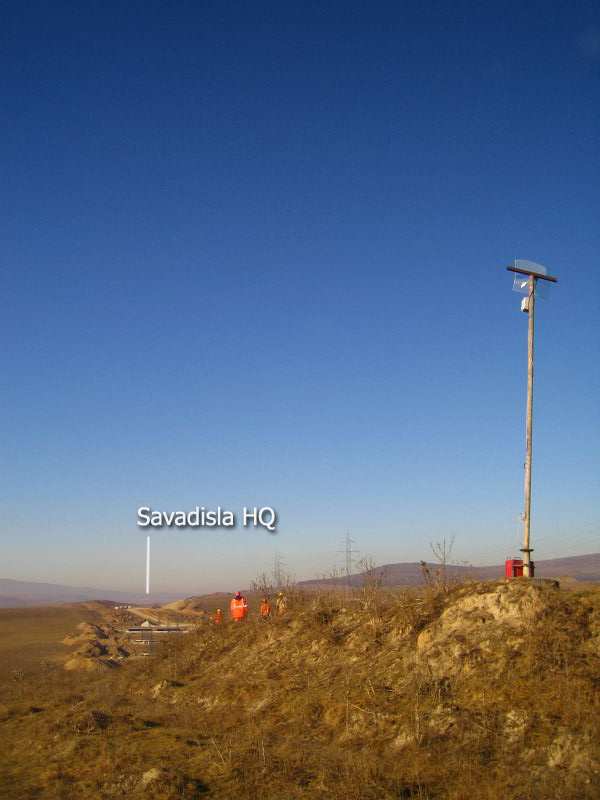
By 18 December 2006 the Săvădisla camp had these links live, all fed by a WRT54GL on a CalAmp 24 dBi parabolic grid facing down the alignment:
- Camp to km29, an 8 km direct line-of-sight link running about 5.5 Mbps raw.
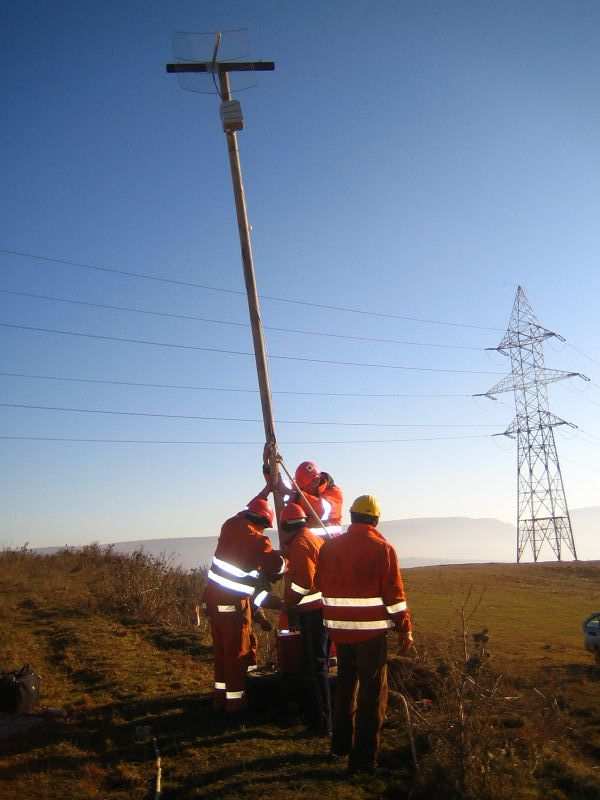
- Camp to km26, which had no line of sight at all, reached over a repeater sitting on a hilltop about 12 km from camp. It ran about 2 Mbps, held down partly by the high-voltage power lines the repeater sat next to.
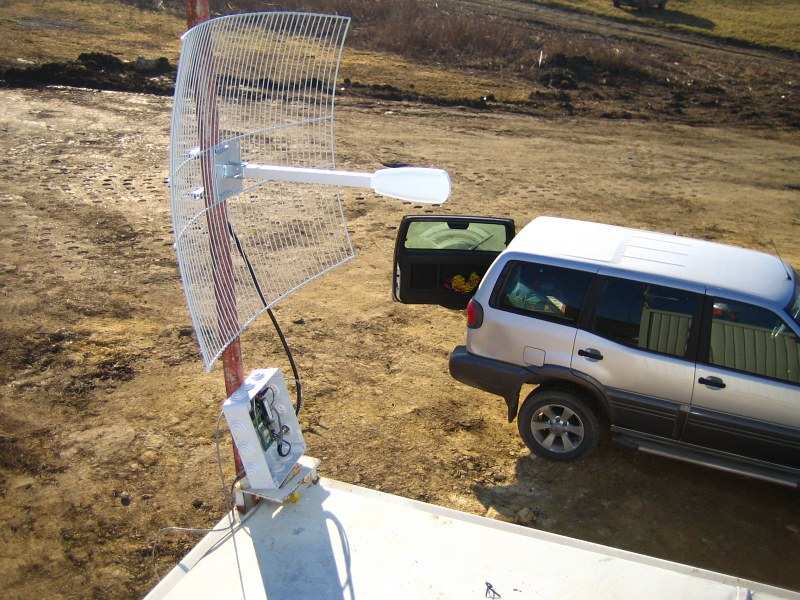
The repeater was the interesting one. A hill sat directly between the camp and km26, so a straight shot was impossible. Putting a WRT54GL in repeater mode on top of that hill turned one blocked path into two clear ones, and the valley behind got its link.
Power on those hilltops was the practical problem. There was no mains supply out there, so the antennas in the field, and the repeaters especially, ran off car batteries. One battery lasted roughly one to two weeks depending on the battery, then someone drove up and swapped it for a charged one.
Inside the camp itself the job was different: the new living quarters needed internet in the dorms. I covered that with a root access point and a set of WDS-configured units forming a small mesh. The area was small enough that even two WDS hops still delivered at least 5.5 Mbps, and users had signal across the whole camp.
The same kit travelled to other parts of the project. At a different location I put up a link of about 22 km, shot over a forest, to bring data to the Suplacu de Barcău viaduct, running from Ip across to Chiribiș. That was the longest one I built, and it held.
Why it holds up#
None of this was exotic. It was consumer routers, open firmware, a few antennas, and weatherproof boxes bolted to poles. But it was all tested in the field and each solution ran at least a month before I wrote it down. That is the part I am still happy with: cheap, repairable, off-the-shelf kit, planned properly, that cut a large fuel bill, kept engineers off the roads and safer, and gave them back the hours they used to lose driving for a drawing.
Links#
- DD-WRT — the open source router firmware.
- ve2dbe.com — Roger Coudé VE2DBE’s radio link simulation software.
- Wireless network connections (PDF, December 2006) — the original write-up, with the theory, equipment, and full router configuration steps.